

박보마: 슬픔, 은빛 가루, 제스처 boma pak: sorrow, silver dust, gesture
박보마: 슬픔, 은빛 가루, 제스처
boma pak: sorrow, silver dust, gesture
강재영 기자
작업의 출발점부터 듣고싶다.
작업의 출발점은 나의 감정일 것이다. 크게는 세계의 유한함과 아름다움에서 오는 슬픔이다. 슬픔, 매혹, 분노, 무력감, 남성/서구 중심적인 사회구조 안에서 자리를 차지하는 것에 대한 의문과 이로부터 소외되는 것들에서 느끼는 감정의 선을 추적하는 것이 작업의 축이다. 그 중심에는 시감각이 있다.
고등학교 때부터 마음속으로 하던 의식이 있었다. 죽은 개를 보거나, 할머니가 힘들게 걸어가는 장면을 봤을 때처럼 연민이 드는 대상과 마주치면, 그들에게 은빛 가루를 뿌리는 상상을 했다. 실제로 뿌린 것은 아니지만, 손가락으로 동그란 모양을 공중에 그리고 그 안에 은빛 가루가 있다고 상상한 후 입으로 불었다. 그리고 그들에게 어떤 은총을 담은 은빛 가루가 뿌려진다고 상상했다. 돌이켜보면 기도였던 것 같다. 내 작업은 마음 안에서는 여전히 은빛 가루를 뿌리는 일과 연결되어 있다.
한편 있는 그대로 보이거나 드러났을 때 의미가 제대로 전달되지 않을 것이란 회의감이 있다. 다른 이들에게 받아들여지지 않을 수 있다는 사실을 인지하는, 자조와 같은 방어기제가 작품 구상의 또 다른 축이다.
작가는 비물질성이 무엇이라 보나? 비물질성이 개입하는 대표적인 작업은?
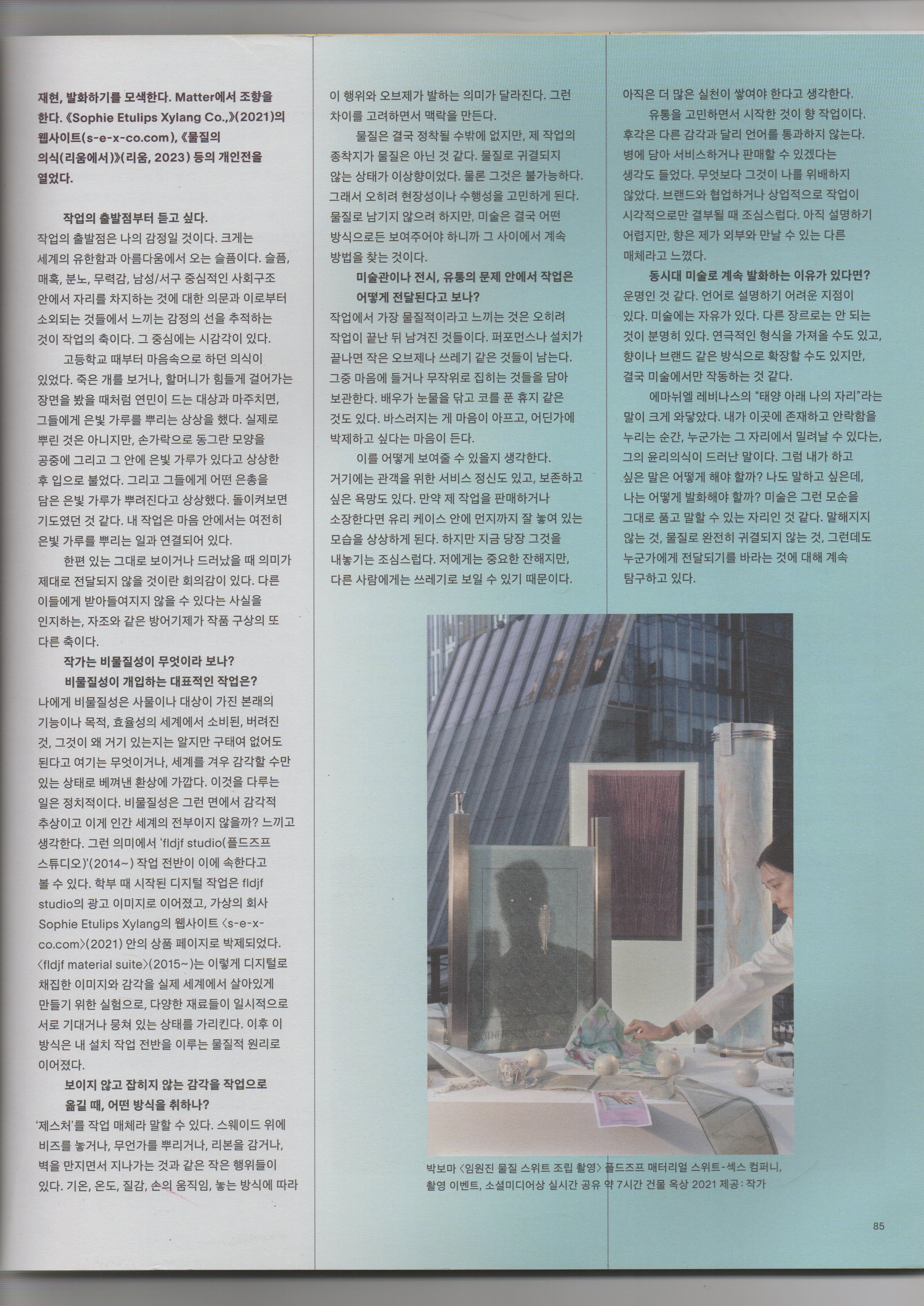
나에게 비물질성은 사물이나 대상이 가진 본래의 기능이나 목적, 효율성의 세계에서 소비된, 버려진 것, 그것이 왜 거기 있는지는 알지만 구태여 없어도 된다고 여기는 무엇이거나, 세계를 겨우 감각할 수만 있는 상태로 베껴낸 환상에 가깝다. 이것을 다루는 일은 정치적이다. 비물질성은 그런 면에서 감각적 추상이고 이게 인간 세계의 전부이지 않을까? 느끼고 생각한다. 그런 의미에서 'fldjf studio(플드즈프 스튜디오>'(2014~) 작업 전반이 이에 속한다고 볼 수 있다. 학부 때 시작된 디지털 작업은 fIdif studio의 광고 이미지로 이어졌고, 가상의 회사 Sophie Etulips Xylang의 웹사이트 (s-e-x-co.com〉(2021) 안의 상품 페이지로 박제되었다.〈fldjf material suite〉(2015~)는 이렇게 디지털로 채집한 이미지와 감각을 실제 세계에서 살아있게 만들기 위한 실험으로, 다양한 재료들이 일시적으로 서로 기대거나 뭉쳐 있는 상태를 가리킨다. 이후 이 방식은 내 설치 작업 전반을 이루는 물질적 원리로 이어졌다.
보이지 않고 잡히지 않는 감각을 작업으로 옮길 때, 어떤 방식을 취하나?
'제스처'를 작업 매체라 말할 수 있다. 스웨이드 위에 비즈를 놓거나, 무언가를 뿌리거나, 리본을 감거나, 벽을 만지면서 지나가는 것과 같은 작은 행위들이 있다. 기온, 온도, 질감, 손의 움직임, 놓는 방식에 따라 이 행위와 오브제가 발하는 의미가 달라진다. 그런 차이를 고려하면서 맥락을 만든다.
물질은 결국 정착될 수밖에 없지만, 제 작업의 종착지가 물질은 아닌 것 같다. 물질로 귀결되지 않는 상태가 이상향이었다. 물론 그것은 불가능하다. 그래서 오히려 현장성이나 수행성을 고민하게 된다. 물질로 남기지 않으려 하지만, 미술은 결국 어떤 방식으로든 보여주어야 하니까 그 사이에서 계속 방법을 찾는 것이다.
미술관이나 전시, 유통의 문제 안에서 작업은 어떻게 전달된다고 보나?
작업에서 가장 물질적이라고 느끼는 것은 오히려 작업이 끝난 뒤 남겨진 것들이다. 퍼포먼스나 설치가 끝나면 작은 오브제나 쓰레기 같은 것들이 남는다. 그중 마음에 들거나 무작위로 집히는 것들을 담아 보관한다. 배우가 눈물을 닦고 코를 푼 휴지 같은 것도 있다. 바스러지는 게 마음이 아프고, 어딘가에 박제하고 싶다는 마음이 든다.
이를 어떻게 보여줄 수 있을지 생각한다. 거기에는 관객을 위한 서비스 정신도 있고, 보존하고 싶은 욕망도 있다. 만약 제 작업을 판매하거나 소장한다면 유리 케이스 안에 먼지까지 잘 놓여 있는 모습을 상상하게 된다. 하지만 지금 당장 그것을 내놓기는 조심스럽다. 저에게는 중요한 잔해지만, 다른 사람에게는 쓰레기로 보일 수 있기 때문이다. 아직은 더 많은 실천이 쌓여야 한다고 생각한다.
유통을 고민하면서 시작한 것이 향 작업이다. 후각은 다른 감각과 달리 언어를 통과하지 않는다. 병에 담아 서비스하거나 판매할 수 있겠다는 생각도 들었다. 무엇보다 그것이 나를 위배하지 않았다. 브랜드와 협업하거나 상업적으로 작업이 시각적으로만 결부될 때 조심스럽다. 아직 설명하기 어렵지만, 향은 제가 외부와 만날 수 있는 다른 매체라고 느꼈다.
동시대 미술로 계속 발화하는 이유가 있다면?
운명인 것 같다. 언어로 설명하기 어려운 지점이 있다. 미술에는 자유가 있다. 다른 장르로는 안 되는 것이 분명히 있다. 연극적인 형식을 가져올 수도 있고, 향이나 브랜드 같은 방식으로 확장할 수도 있지만, 결국 미술에서만 작동하는 것 같다.
에마뉘엘 레비나스의 태양 아래 나의 자리"라는 말이 크게 와닿았다. 내가 이곳에 존재하고 안락함을 누리는 순간, 누군가는 그 자리에서 밀려날 수 있다는, 그의 윤리의식이 드러난 말이다. 그럼 내가 하고 싶은 말은 어떻게 해야 할까? 나도 말하고 싶은데, 나는 어떻게 발화해야 할까? 미술은 그런 모순을 그대로 품고 말할 수 있는 자리인 것 같다. 말해지지 않는 것, 물질로 완전히 귀결되지 않는 것, 그런데도 누군가에게 전달되기를 바라는 것에 대해 계속 탐구하고 있다.
Where does the starting point of your work come from?
The starting point of my work is my emotions, I think. Broadly, it's a sadness that comes from the finitude and beauty of the world. Sadness, fascination, anger, powerlessness — tracing the line of emotion that comes from questioning what it means to occupy a place within a male- and Western-centered social structure, and what gets alienated in the process — that's the axis of the work. At its center is a sense of vision.
Since high school I've had a private ritual. When I encountered something that stirred pity in me — seeing a dead dog, or watching an old lady walk with difficulty — I would imagine scattering silver dust over them. I never actually scattered anything; I would draw a circle in the air with my fingers, imagine silver dust inside it, and blow it into the air. I imagined that some kind of grace-laden silver dust was being scattered over them. Looking back, I think it was a kind of prayer. In my heart, my work is still connected to that act of scattering silver dust.
At the same time, there's a skepticism that meaning won't come across properly if it's shown or revealed as it is, plainly. A defense mechanism — something like self-mockery, an awareness that others might not accept it — is another axis shaping how I conceive my work.
How do you understand immateriality? What are the works where immateriality is most present?
To me, immateriality is close to something consumed and discarded from the world of an object's original function, purpose, or efficiency — something whose presence you understand but that you'd say doesn't really need to be there — or a fantasy that copies the world down to a state where it can barely be sensed at all. Handling this is a political act. In that sense immateriality is a kind of sensory abstraction, and I wonder — isn't this perhaps the whole of the human world? That's how I feel and think about it. In that sense, the entirety of my fldjf studio (2014–) practice can be said to belong to this. The digital work I began in undergrad carried on into fldjf studio's advertising images, and was fossilized as product pages within the website of the fictional company Sophie Etulips Xylang, s-e-x-co.com (2021). fldjf material suite (2015–) is an experiment to keep these digitally gathered images and sensations alive in the the substantial world — it refers to a state where various materials temporarily lean on or cluster with one another. This approach later became the material principle running through my installation work as a whole.
When translating an invisible, ungraspable sense into work, what approach do you take?
I could say "gesture" is my medium. Small acts — placing beads on suede, scattering something, winding a ribbon, touching a wall with my palm and fingers as I pass by. Depending on temperature, texture, the movement of the hand, and how something is placed, the meaning given off by the act and the object changes. I build context while accounting for those differences.
Matter inevitably comes to settle somewhere, but I don't think the destination of my work is matter itself. A state that never resolves into matter was the ideal — of course, that's impossible. So instead, I find myself thinking about presence and performativity. I try not to leave things behind as matter, but art ultimately has to show itself in some form, so I keep searching for a way to work within that gap.
Within the context of museums, exhibitions, and distribution, how do you see the work being conveyed?
What I find most material in my work, oddly enough, is what's left behind after the work is over. After a performance or an installation ends, small objects or trash-like things remain. I gather and keep some of these — the ones I like, or ones picked up at random. There are things like tissues an actor used to wipe tears or blow their nose. It pains me to see them crumble away, and I feel the urge to preserve them somewhere.
I think about how I might show these. There's a spirit of service toward the audience in that, and also a desire to preserve. If I were to sell or have my work collected, I imagine even the dust being carefully placed inside a glass case. But right now, I'm cautious about presenting that. To me, it's important remains — but to someone else, it might just look like trash. I think more practice needs to accumulate before that.
Olfactive work began out of thinking about distribution. Unlike other senses, smell doesn't pass through the part of the brain that governs language — it goes straight to the brain. It occurred to me that it could be bottled and offered as a service or sold. Above all, it didn't betray who I am. I'm cautious when a work becomes tied to a brand collaboration or something commercial only through its visual surface. It's still hard to explain, but I felt that scent was another medium through which I could meet the outside world.
Is there a reason you keep speaking through contemporary art?
It feels like fate. There's something hard to explain in language. Art has freedom. There are clearly things other genres can't do. I can borrow theatrical forms, or expand into scent or branding — but in the end, it seems like something that only works within art.
Emmanuel Levinas's phrase "my place under the sun" resonated deeply with me. It reveals his ethical awareness — that the moment I exist here and enjoy comfort, someone else may be pushed out of that very place. So then, how should I say what I want to say? I want to speak too — but how should I speak? Art seems to be a place that can hold that contradiction as it is, and still speak. I keep exploring what isn't said, what never fully resolves into matter, and yet still hopes to reach someone.
Translation by Sophie
Featured in Monthly Art (월간미술), June 2026 issue, in the special "The Dematerialization of Art — Creation, Exhibition, Distribution." The interview engages one of the core preoccupations in my practice. Feature by editor Noh Jae-min; interview by editor Kang Jae-young.
